YJ-17 Hypersonic Anti-Ship Missile
A verified technical analysis of the navalized boost-glide effector unveiled at the 2025 Victory Day Parade.
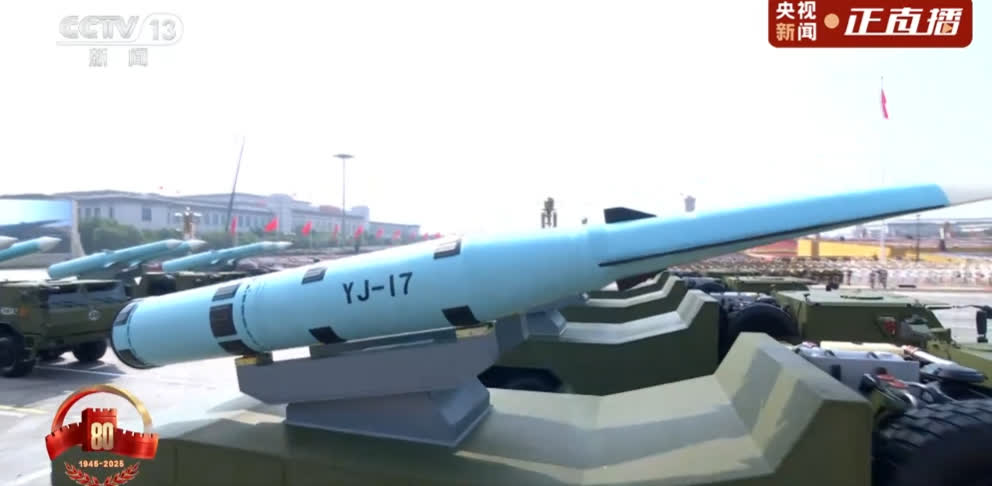
The YJ-17, mounted on a Transporter-Erector-Launcher (TEL), during the 2025 parade preparations.
1. Executive Summary
The Yingji-17 (YJ-17) is a hypersonic anti-ship aeroballistic missile featuring an unpowered hypersonic glide vehicle (HGV) payload, developed under the oversight of CASIC's 1st Academy (10th Research Institute). Publicly debuted on September 3, 2025, during China's Victory Day Parade, this system represents a critical navalized extension of the land-mobile DF-17 medium-range ballistic missile system. Scaled down and engineered with folding control surfaces, the YJ-17 is adapted specifically for universal vertical launch systems (UVLS) to penetrate state-of-the-art shipborne air defense networks and alter the strategic balance of power in the Western Pacific.
2. Technical & Trajectory Analysis
Propulsion & Aerodynamics
Definitively rejecting turbojet or scramjet cruise claims for this system, technical consensus confirms the YJ-17 relies on a two-stage solid rocket motor to achieve hypersonic upper-atmosphere velocities. Upon booster separation, it releases an unpowered, wedge-shaped waverider HGV. This configuration leverages flat-bottomed geometry to ride the shockwaves generated during atmospheric flight, optimizing lift and enduring high dynamic pressure.
Verified Performance Specifications
- System Type: Hypersonic Aeroballistic Missile (HGV payload)
- Total Mass: Estimated 3,000 - 4,500 kg (supports booster propellant requirements)
- Speed Profile: Mach 6 mid-course cruise; accelerating to Mach 10 in terminal dive
- Trajectory Profile: Depressed Sanger-Tsien 'skip-glide' trajectory at 50-60 km altitude
- Warhead Weight: Estimated 300 - 400 kg (Conventional / Armor-Piercing)
Guidance & Sensor Architecture
To guarantee precision targeting at extreme velocities, the YJ-17 utilizes a redundant, multi-layered guidance suite. Mid-course pathing relies on an integrated Inertial Navigation System (INS) continuously corrected by BeiDou satellite updates and off-board sensor datalinks. Terminal homing integrates an active single-pulse radar seeker paired with an Imaging Infrared (IIR) sensor, allowing it to filter out intense electronic countermeasures and decoys to successfully isolate target warships.
3. Platform Integration & Operational Doctrine
Launch Platform Optimization
The YJ-17 has been dimensionally tailored to fit China's standard HT-1 Universal Vertical Launch System (UVLS) cells (maximum 850 mm diameter envelope), deployed in depths of 7 m or 9 m aboard Type 055 large destroyers and Type 052D destroyers. Beyond surface fleets, naval intelligence identifies the weapon as a prime candidate for vertical launch tubes (VLS) aboard next-generation Type 095 (Type 09V) nuclear attack submarines (SSNs), providing a highly survivable, long-range subsurface weapon for surprise vertical diving strikes.
The Coordinated Two-Wave Strike Doctrine
Deployed alongside the heavier YJ-20 aboard the Type 055 destroyer, the YJ-17 establishes a devastating joint combat capability, making the Type 055 the first warship class globally armed with dual-hypersonic anti-ship variants. This enables a specialized, sequential tactical doctrine optimized to neutralize Carrier Strike Groups (CSGs):
Fired first to leverage its highly irregular atmospheric skip-glide profile and Mach 8-10 terminal velocity. Its operational priority is penetrating the target fleet's outer defensive screen, systematically destroying Aegis escorts (cruisers/destroyers) and rendering the core fleet defenseless.
Launched immediately following the initial suppression. The heavier YJ-20 utilizes a double-cone maneuverable reentry vehicle (MaRV) traversing a high-altitude ballistic path to execute a near-vertical 'top-attack' (灌顶). Diving past Mach 10 with 15-G maneuverability, it pierces the aircraft carrier flight deck to deal a decisive shock blow.
4. Aerodynamic & Thermodynamic Reality Checks
A rigorous evaluation using aerospace engineering principles disproves popular internet database claims and social media theories suggesting the YJ-17 is a low-altitude sea-skimmer or a hybrid dual-mode propulsion missile:
Online enthusiasts argue that a 20-meter altitude altitude trajectory slides under radar horizons. However, calculating dynamic pressure using $q=\frac{1}{2}\rho v^{2}$ shows that at sea level ($\rho \approx 1.225 \text{ kg/m}^3$) and Mach 8 ($2,720 \text{ m/s}$), the airframe experiences a crushing structural loading of 4.53 MPa (45 times standard atmospheric pressure). No known aerospace alloy can withstand such shear stress. At verified upper altitudes of 60 km, the atmospheric density drops drastically ($\rho \approx 3.0 \times 10^{-4} \text{ kg/m}^3$), making the dynamic pressure a perfectly manageable $1.11 \times 10^3 \text{ Pa}$.
Aerodynamic heating scales via $Q \propto \sqrt{\rho}v^3$. At sea level, a Mach 8 velocity creates a searing thermal environment that far exceeds the maximum structural melting threshold of ultra-high-temperature ceramics (UHTCs) such as Hafnium Diboride ($HfB_2$, which melts at $\approx 3,250^\circ\text{C}$), melting the frame instantly.
Certain regional defense forums claim the YJ-17 skims the sea subsonically before activating a terminal ramjet sprint. This profile directly contradicts the verified solid-fuel boost-glide design of the missile. Such reports are conflating the YJ-17 with the air-breathing ramjet YJ-15 or scramjet-powered YJ-19. Similarly, claims of exporting a 6.7 m land-attack variant for Pakistan's Hangor-class conventional submarines are structures of misattribution: the Hangor-class utilizes horizontal 533 mm torpedo tubes and entirely lacks vertical launch cells, rendering it structurally unable to house or support the larger solid booster necessary for the VLS-bound YJ-17.
5. Database Reconciliations & Emerging Speculation
The following entries compile resolved database discrepancies alongside open-source military analytical speculation from specialized defense blogs (e.g., Sina Military Forum):
- Corrected Database Anomalies: Early internet databases misidentified the YJ-17 as a 600-800 kg subsonic sea-skimming cruise missile propelled by a small turbojet, with small dimensions (4-5 m length, 0.3-0.4 m diameter). Defense data from the August/September 2025 parade finalized its true operational parameters as a heavy 3.5-ton-class boost-glide strategic tool.
- AI-Assisted Autonomous Terminal Guidance: Defense analysts suggest the HGV payload integrates an advanced neural-network-driven computing suite. This would theoretically allow the waverider to autonomously distinguish priority flagships (such as fleet carriers) from surrounding escorts and adjust optimal terminal weaving maneuvers to fully saturate close-in weapon systems (CIWS).
- Networked In-Flight Swarm Communication: A prominent theory on specialized blogs indicates that the YJ-17 family can maintain high-speed inter-missile tactical datalinks during the high-altitude glide phase, dynamically sharing target allocation details to swarm and overwhelm regional fleet networks simultaneously from multiple vectors.
- High-Power EMP Fleet Neutralization Options: While the primary ordnance relies on a heavy conventional armor-piercing kinetic warhead, unverified posts claim CASIC has engineered a specialized variant carrying a non-nuclear high-power electromagnetic pulse (EMP) payload designed to burn out shipborne Aegis active phased array electronics prior to kinetic impact.